

Kond historic district is a residential neighbourhood on elevated ground in central Yerevan, with a street layout that dates back to the 17th century. Its steep lanes, shared courtyards and historic landmarks make it a distinctive city walk; because people live here, explore quietly and treat homes and courtyards as private spaces.
- Where: Kentron, on a hill in central Yerevan.
- Character: Narrow, uneven, steep lanes with hillside houses arranged like steps.
- Historic details: Residential architecture, the Church of St. John the Baptist and remains of a Persian-period mosque.

Where Kond sits in Yerevan
Kond occupies elevated ground in Kentron, Yerevan’s central administrative district. The Yerevan tourism listing describes it as one of the city’s oldest districts and gives its area as about 16 hectares.
The name refers to the neighbourhood’s high position: “Kond” is explained as meaning an elongated or rounded hill. Its street layout has remained in place since the 17th century, according to an Armenian tourism article, giving the district a different shape from the surrounding central streets.
For a broader city outing, Kond can fit into a one-day Yerevan walking route from the city centre, with the neighbourhood as one part of the day rather than a separate destination.
What to notice on a walk
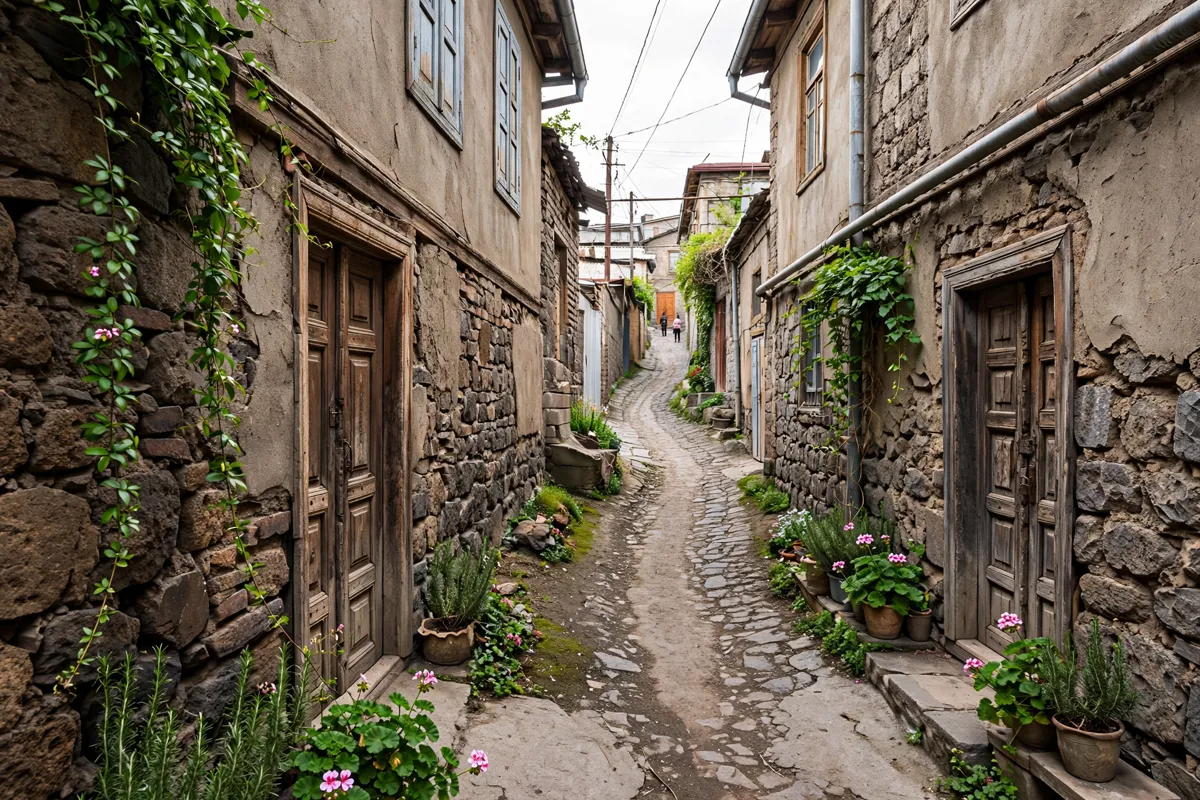
Kond’s lanes are narrow, uneven, steep and radial, while hillside houses rise in a staircase-like pattern. Take your time on the sloping streets and look at the changing rooflines and facades as the lanes climb.
The Yerevan tourism listing describes many homes as single-storey earthen houses, often connected and arranged around shared courtyards. Uneven-brick walls and wooden doors are among the details that give the residential streets their character. Grapevines, once part of the district’s orchards, still appear in courtyards and along streets.
The Church of St. John the Baptist is identified as a longstanding central institution in Kond, alongside its parish school. The district also contains a remaining wall of the Tapebashi Persian mosque, estimated to date to 1687.
The tourism listing describes a mosque and attached school that ceased functioning in 1828; it also records that refugee families took shelter in the dilapidated mosque in 1915 after the Armenian Genocide.

How to explore respectfully
Kond is a lived-in residential area, so keep your walk considerate: stay on the lanes, avoid entering courtyards or homes, and keep noise low. Its close-set houses and narrow streets make it especially important to leave residents room to pass and to respect private spaces.
Notice the neighbourhood as a whole as well as individual buildings. Two historic canals, Mamri and Abuhayati, once passed through Kond, and the streets still trace a long-established pattern through the hillside. The old-Yerevan character here is part of a residential setting, not a staged attraction.
How do you get to and around Kond?

From Bonjour Boutique, Kond is about 0.3 km away. Pedestrian approaches named in the official Kond rehabilitation concept include Saryan Street and stairs near the Central Post Office. The district’s main pedestrian route passes through Rustaveli Street; other stairs lead toward Frik Street and the House of Composers.
As you walk, expect slopes and uneven surfaces rather than a level route. Plan any wider city journey using public transport information before approaching Kond on foot.
Check the Yerevan Municipality’s official site before you go.
FAQs
What does “Kond” mean?
The name refers to the district’s elevated position and is explained as meaning an elongated or rounded hill.
How large is Kond?
The Yerevan tourism listing gives the historic district’s area as about 16 hectares.
What historic landmark is central to the neighbourhood?
The Church of St. John the Baptist is described as a longstanding central institution in Kond, with a parish school.
Are Kond’s lanes flat and easy to navigate?
No. The lanes are described as steep and uneven, so allow time for a hillside walk.
How can you plan public transport in Yerevan?
Yerevan’s public transport guide covers the metro, buses and route planning for getting around the city.